

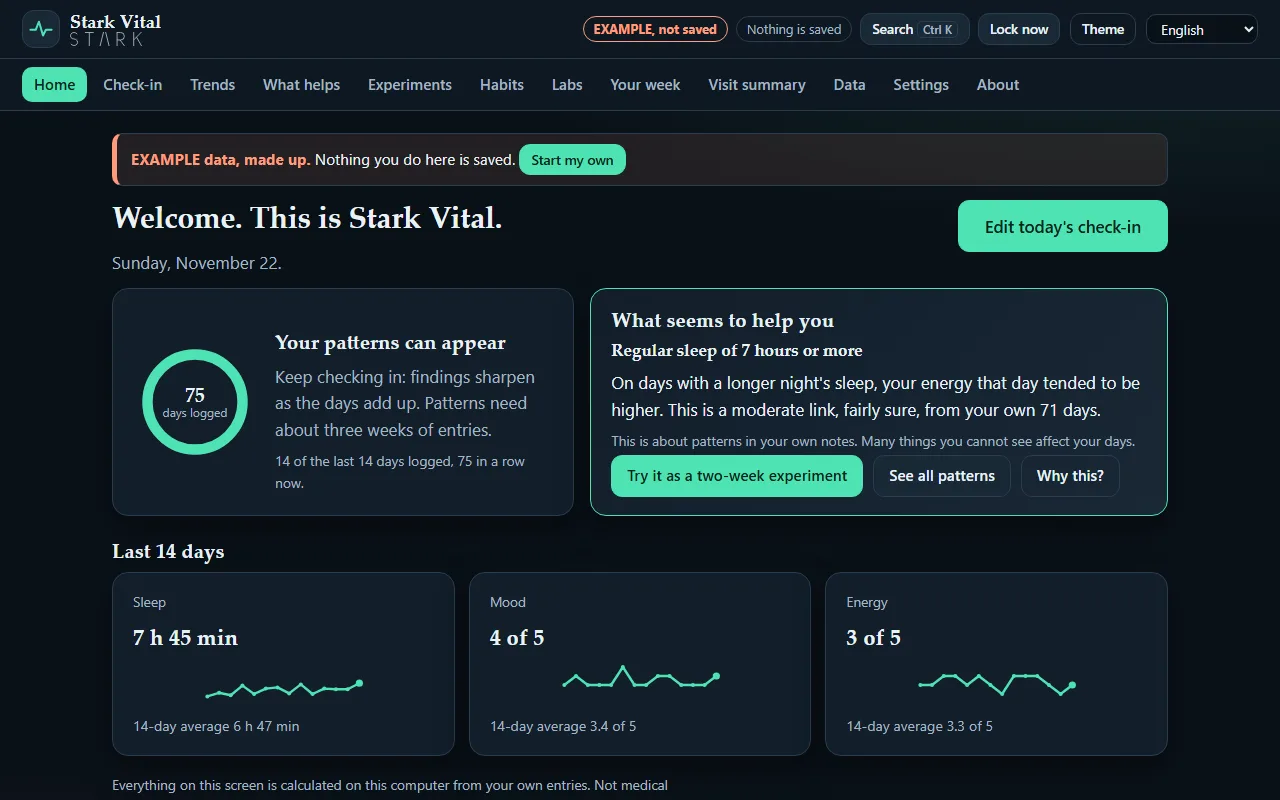


Stark Vital is a private notebook that notices patterns in your own days. A daily check-in takes a few taps. After about three weeks of entries it can show which habits tended to go with better sleep, mood or energy for you, with how many days it looked at and how sure it is. You can also run a two-week experiment on one habit and see what changed.
Everything is encrypted on your computer with your passphrase. There is no account, no server and no network access, and nothing is sent anywhere. Pay once.
Not medical advice. Stark Vital is a self-tracking and habit tool. It is not a diagnosis, and it does not tell you what a result means for your health.
What you get
- A fast first run. Look around with a made-up example dataset (marked EXAMPLE everywhere, never saved), or start your own in about a minute.
- A short daily check-in. Sleep (bed and wake time, how rested), mood, energy, and optionally focus, stress, training, light, caffeine, alcohol, time with people, slow breathing, a note. Everything is optional. On the check-in the keys 1 to 5 pick an answer and move on.
- Trends. Charts of sleep length, ratings, steps and bedtime regularity over 7, 30, 90 or 365 days, with a 7-day average, a weekday view, and a table for every chart.
- What seems to help you. Plain statistics on your own entries: Spearman rank correlation with weekday differences removed, a block bootstrap for how sure it is, and a correction for checking many pairs at once. It shows how many days it used. It says "might be chance" when that is what the numbers say, and it says "not enough data yet" until it has 21 paired days.
- Two-week experiments. Pick one habit from the library, one result to watch and the smallest change that would matter to you. The rules for judging the result are shown before you start and cannot move afterwards. Results are labelled clear change, possible change, no clear change or too little data, with how often you did the habit.
- Nine everyday habits with sources. Sleep, movement, strength, steps, morning daylight, caffeine timing, alcohol, slow breathing and time with people. Each shows what public research says, who said it and the date it was checked. These summarise studies about groups of people, so your own results may differ.
- Lab results you type in. Copy a result and the range printed on that report. Stark Vital draws each result with its own report's range and says only below, inside or above that range. It never converts units and has no built-in ranges.
- Your week. The last 7 days against the 7 before: three things that changed, one that stayed steady, one thing to try. No scores.
- A one-page visit summary you can print or save as PDF, with your 30-day averages, your lab results with their own ranges, and your questions for the doctor.
- Three levels of detail. Simple, More and Expert (rho, Cliff's delta, p-values, false-discovery rate). The setting changes what is shown, never how it is calculated.
- Keyboard and phone-width friendly. Layouts for phone-width screens (checked in an emulated phone browser), light and dark themes, adjustable text size, a reduced-motion setting, a data table behind each main chart, Ctrl+K to jump or search.
Private by design
- Your entries are stored in your browser as one encrypted record (AES-256-GCM, key from your passphrase with PBKDF2-SHA256, 600,000 rounds). A new random value is used on every save.
- The page loads nothing from the network, and its security policy blocks every connection. There is no analytics and no crash reporter.
- Export an encrypted backup, or a plain CSV (with a warning first). Delete everything with one typed word.
- If you lose your passphrase, your data cannot be recovered. Keep an encrypted backup file somewhere safe.
What it is not
Not medical advice and not a diagnosis. It does not tell you what a result means for your health, does not suggest medicines, supplements or hormones, and does not cover steroids, peptides or any drug. If something worries you, talk to a doctor or pharmacist. In an emergency, call your local emergency number. If your own entries show something worth a doctor's attention (for example five days in a row at the lowest mood rating), it shows a plain note saying so and pauses experiments.
Honest limits
Self-ratings are noisy and a few weeks of notes is a small sample. A pattern is not a cause. An experiment runs one at a time and cannot separate a habit from other things that changed in the same weeks. Sleep length comes from the clock times you type, so it can be an hour off on the night the clocks change. The free trial covers up to 14 days of your own entries, which is below the 21 paired days patterns need, so in the trial the pattern finder is best seen on the built-in example data.
Sources
The habit list, with links and the date each was checked, is in the app (Habits) and in the sources below. Each source was opened and read (abstract only where the full text is not openly available) and the wording in the app was kept no stronger than the source.
- Watson NF et al., Journal of Clinical Sleep Medicine 2015;11(6):591-592 (AASM and SRS consensus statement on sleep of 7 or more hours).
- Bull FC et al., British Journal of Sports Medicine 2020;54:1451 (WHO guidelines on activity and muscle-strengthening).
- Paluch AE et al., Lancet Public Health 2022;7:e219-e228 (daily steps).
- Dautovich ND et al., Sleep Health 2019;5(1):31-48 (systematic review of light and sleep).
- Gardiner C et al., Sleep Medicine Reviews 2023;69:101764 (caffeine and sleep).
- Gardiner C et al., Sleep Medicine Reviews 2025;80:102030, and Hu N et al., Drug and Alcohol Dependence 2020;217:108259 (alcohol and sleep).
- Shao R, Man ISC, Lee TMC, Mindfulness 2024;15(1):1-18 (slow paced breathing).
- Holt-Lunstad J, Smith TB, Layton JB, PLoS Medicine 2010;7(7):e1000316 (social relationships).
Not claimed
No health outcomes, no user counts, no ratings, no certifications, no comparison with other products. It does not use an online service or a trained model: "learns on your device" means plain statistics recomputed from your own entries.