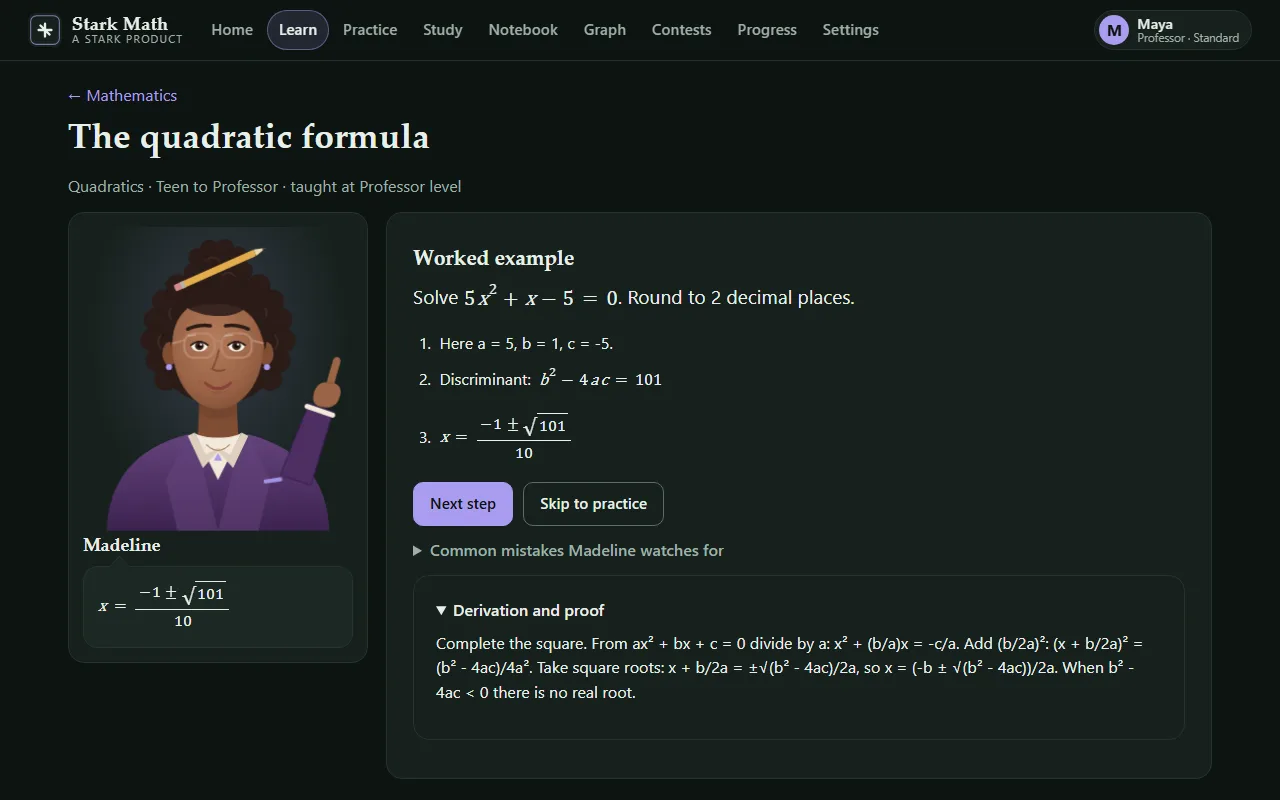
Stark Math is a maths and science tutor that works without an internet connection. Its teacher, Madeline, walks you through a worked example, then lets you try. If you get stuck she gives a nudge, then a hint, then the next step. If your answer is wrong, she looks at what you actually typed and tells you what probably went wrong: added the denominators, dropped a minus sign, worked left to right instead of following the order of operations, forgot to square the speed, mixed up kilometres and metres.
New in version 1.1
- Placement check: about 10 adaptive questions find the right starting level, from Grades K to 2 up to college.
- Review (spaced repetition): every skill comes back just before it is forgotten, after 1 day, then 3 days, then longer gaps. A slip brings it back at once. A seven-day forecast shows what is coming.
- Word problems: 7 new story skills (add or subtract, equal groups and remainders, shopping and change, fractions of amounts, discounts, best buys, stories that need an equation). Every solution follows four steps: Understand, Plan, Solve, Check. Teachers and parents can build their own word problems with number slots and an answer formula; the app works out every variant exactly and the sets can be shared as files.
- Algebra step checker: type your working one line at a time. Every line is checked exactly against the line above, and the first slip is explained (a term moved without changing sign, one side changed but not the other, a bracket not fully expanded, a missing second solution).
- Fact fluency: one-minute sprints on addition, subtraction, times tables and division facts, with a grid that shows which facts are fluent, slow or missed.
- Worksheets with answer keys: pick any skills and level, print the sheet and its key (or save as PDF from the print dialog). A sheet code rebuilds exactly the same problems later.
- Curriculum map: every skill by grade band, with ages, international (ISCED) and England and Wales equivalents, and US maths (Common Core) and science (NGSS) reference codes. Search by code, download the map as CSV.
- Parent and carer report: a printable page with activity, accuracy, strong skills, skills to work on, reviews due and written suggestions for home.
- Reading support: Plain words, Standard or Detailed, set per learner and separate from the maths level. Plain words swaps hard words for everyday ones and explains maths words the first time they appear; the maths never changes.
Meet Madeline (and what she is not)
- She is a rule-based teaching guide: her explanations, hints and mistake checks were written by people as rules and templates. She is not an AI and not a real person, so she cannot chat. She can check your answer exactly, explain every step and adapt to your level.
- She has six expressions, blinks, gestures, and moves her mouth while reading aloud, using the voices your device already has.
Five levels that change everything
Kid (about 5 to 10), Teen (11 to 17), Adult, University and Professor, each with a Gentle, Standard or Challenge setting, plus grade-band presets (K to 2 up to graduate). The level changes the size of the numbers, the words Madeline uses, how much she explains, the notation, and at the top levels adds derivations and proofs (20 of them, from the quadratic formula to the particle in a box).
What's inside: 187 skills
- Mathematics (73): arithmetic and place value, fractions, decimals, percentages, ratios, integers, order of operations, pre-algebra, linear equations and inequalities, systems, exponents and roots, polynomials and factoring, quadratics, functions and graphing, geometry (area, perimeter, angles, Pythagoras, volume), statistics and probability, introductory trigonometry.
- Word problems (7): new in 1.1, see above.
- Physics (52): kinematics, forces, energy, momentum, waves, electricity and circuits, optics, thermodynamics, and at the top levels relativity and quantum physics.
- Chemistry (14), calculus (9), linear algebra (8), probability and statistics (8), computer science (9) and engineering basics (7).
Answers checked exactly
- Every problem is generated fresh and checked by the app's own exact maths engine. Equivalent answers count: 1/2, 0.5 and 2/4 are all accepted where the question allows it, and Madeline asks you to simplify when the skill is about simplifying.
- Science answers take units: 90 km/h is accepted for 25 m/s, 1 kWh for 3.6 MJ, 26.9 °C for 300 K. A unit for the wrong kind of quantity is caught ("that unit measures a speed, but the question asks for an acceleration"), and significant figures are checked sensibly.
- Physical constants are the CODATA 2018 values; atomic masses are IUPAC standard values.
Also included
- Mastery tracking per skill and adaptive practice that brings back weak skills more often.
- Notebook with a built-in maths renderer (fractions, powers, roots). End a line with "= ?" and it works the answer out exactly.
- Graphing tool for up to four functions, with zoom, pan, trace, a table of values and a plain-language summary.
- Contests, all offline: timed rounds from an event code (everyone at the same level gets the same problems), couple and family matches where a child and a parent take turns at their own levels on one device, classroom, business and college events, and a monthly Stark Challenge. Results move as signed files (USB stick, email, a school share); organisers get leaderboards with tie-breaks, team tables, brackets and printable certificates. Event codes made with version 1.0 give the same problems in 1.1.
Privacy
- No accounts, ads, analytics or network calls. Fonts are your system's own.
- Profiles, progress, notebook pages, worksheets and your own word problems are saved in your browser on your device. Back up everything in Settings moves them to another computer.
Good to know (honest limits)
- English only: the interface and every problem are in English. There is no Spanish (or other) translation yet.
- Curriculum codes are our own alignment to help you find skills. They are codes only (no standard text), and they are not an official or certified mapping. Other countries' curricula are shown as grade-band equivalents.
- Placement gives a starting level from about 10 questions. It is a quick guide, not a formal assessment.
- The algebra checker handles linear and quadratic equations in one letter and polynomial expressions. It does not check inequalities, letters in a denominator or simultaneous equations.
- Read-aloud uses your browser's voices, so how Madeline sounds depends on your device; some devices have none. Her speech bubble always shows the words.
- Typing maths: answers are typed as text (for example
3/4, x^2 - 5x + 6, 12.5 m/s); a keypad helps on touch screens. There is no handwriting input. - Money in word problems is shown in dollars. Answers can be typed with or without the currency sign.
- Contest result files are signed so hand edits are detected, and organisers re-score every answer. Someone who rebuilds the app could still forge a file, so for high-stakes events supervise the room as you would for a paper test.
- Playing on itch: progress is saved for this page in your browser. Use backups or the offline download to keep it long-term.
- The skills are deep rather than exhaustive (for example, no proofs-by-induction practice yet and no 3D graphing).